Guide
What Was the Roman Dodecahedron Used For? Every Theory Compared
Key points
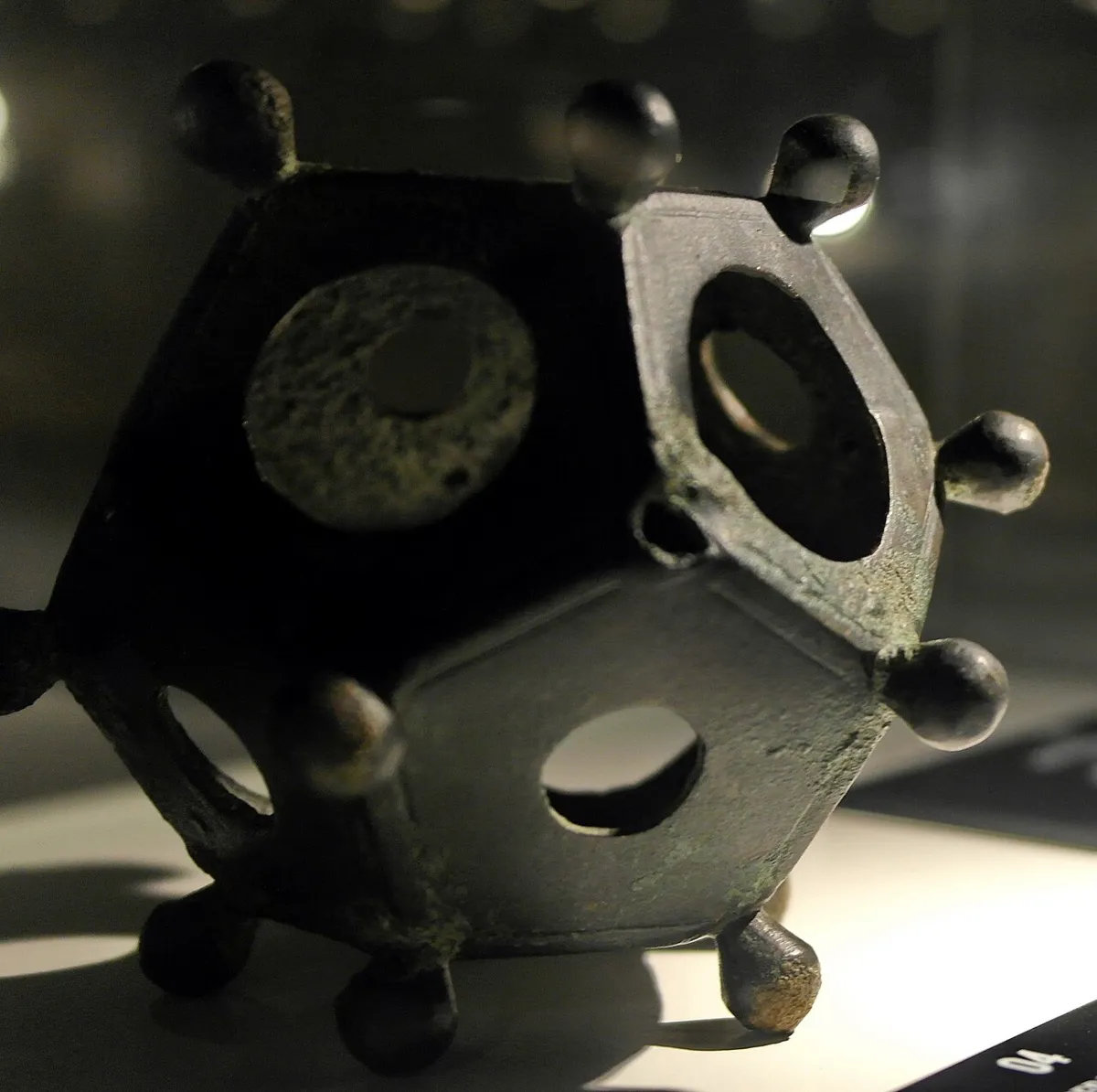
Why it is so hard to say
No contemporary account or picture mentions dodecahedra, and many were found without a clear archaeological context.[W] The Norton Disney find is unusual because it came from a recorded excavation, in a backfilled quarry pit.[NCWC]
Comparison table
| Theory | How it would work | For | Against |
|---|---|---|---|
| Surveying / rangefinder | Sighting distant objects through pairs of holes | — | No markings to show it was a mathematical instrument[W] |
| Spool-knitting tool | Knitting glove fingers around the knobs | Modern demonstrations are possible | Earliest spool-knitting reference is 1535; bronze is an odd choice; the related icosahedron lacks the needed holes[W] |
| Ritual / fortune-telling | Used in religious or magical practice | Dodecahedron's significance in classical philosophy; mostly Gallo-Roman sites[W] | No direct evidence |
| Coin gauge | Checking coins fit a diameter and weren't clipped | Several found in coin hoards[W] | Unproven |
| Metalsmith's test piece | A casting showcase or guild qualification | High cost of bronze and skill needed[W] | Speculative |
| Child's toy | Plaything | — | Speculative[W] |
| Weapon / mace head | 19th-century antiquarian idea | — | Too light to be effective[W] |
| Scepter, land-measuring tool and others | Various | Mentioned by a museum curator | “None of them is satisfying”[LS] |
What experts say
Guido Creemers, a curator at the Gallo-Roman Museum in Tongeren, told Live Science that ideas such as a land-measurement instrument or a scepter are not satisfying, and that the museum thinks the objects had to do with non-official activities like sorcery or fortune-telling.[LS] The National Civil War Centre notes theories ranging from a spaghetti measurer to a puzzle game or a ritual object.[NCWC]
Is the mystery solved?
No. Their purpose or meaning remains unknown.[W]
FAQ
What is the most likely theory?
No theory is proven. Many scholars point to a ritual or fortune-telling use, but that is still an inference.
Were they knitting tools?
It is a popular idea, but the earliest known reference to spool knitting is from 1535. See our knitting theory guide.
Is the mystery solved?
No.